

Proposed MachairWind Offshore Wind Farm
Updated note, Iona Community Council, April 2026
MachairWind is a proposed offshore wind farm south of Iona covering an area equivalent to more than half the landmass of Mull. It comprises 91 x 340 meter tall turbines, which would be among the tallest currently operational in the world, and – compared to other vast turbines would be sited close to land (12.95 miles from Iona).
In May 2026, ScottishPower Renewables will submit an application to the Scottish Government’s Marine Directorate seeking consent for MachairWind to proceed. Iona Community Council consulted with the island community in March on whether to object to the
proposal. The outcome was:
From ~two-thirds (64%) of households –
• Object to MachairWind = 92%
• ‘No objection to objecting’ = 5%
• Support MachairWind proposal = 3%
In almost every case, those who object stressed very strongly that they support renewables and net zero transition, and went to considerable effort to explain their reasoning.
*Please note the Endnote on images methodology*
Context
Island communities – described by the developer as “host communities” – will have 28 days to support or object to SPR’s planning application once it is submitted in May.
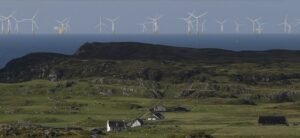
From Cnoc Mor south.
Despite nearly two years of interaction with the developer, it has been difficult to obtain a clear picture of the project’s scale, impacts, costs and benefits. For example, there is currently only one photomontage from Iona, taken with a wide-angle lens that makes distant structures appear smaller than they would to the human eye.
This briefing summarises what we have been able to establish.
The Proposal
MachairWind is proposed as a 2 GW wind farm owned by Iberdrola (Spanish multinational) through ScottishPower Renewables (SPR).
The development would cover an area equivalent to around 58% of the landmass of Mull.
The turbines proposed are exceptionally large:
• 91 turbines that are 340 metres high to blade tip
• Or 147 turbines at 260 metres high
MachairWind turbines would be among the tallest in the world (tallest currently = DEC 26MW at 340-350 m) and relatively close to land for that scale of turbine:
• Dogger Bank windfarm (partially installed since 2025) has the UK’s current tallest turbines at 260 m, sited 78-124 miles from land
• MachairWind’s 340 m turbines will be 7.7 miles from Colonsay and 12.95 miles from Iona – therefore very close to a ‘nearshore’ (~0-6 miles) rather than ‘offshore’development
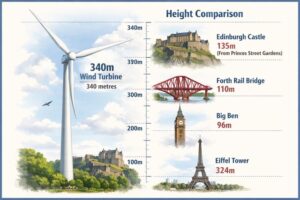
For comparison, the MachairWind turbines would be taller than any building in Europe excluding Russia. A 340 m turbine is higher than the Eiffel Tower (324 m) – and almost exactly equivalent to Big Ben (96 m) on top of the Forth Road Bridge (110 m) on top of Edinburgh Castle (135 m) (total 341 m).
From Iona looking south, turbines would extend across the horizon from Colonsay in the east and beyond Iona’s machair to the west. From Staffa they would be visible above the skyline of Dun I.Iona
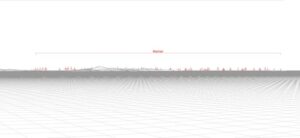
SPR’s graphic of the turbines viewed from Staffa
Where Would the Power Go?
Electricity from the wind farm would be exported by subsea cable to a gridconnection in South Ayrshire, then distributed north towards Kilmarnock and south to Wales.
No electricity would be distributed to the island communities described as “host communities”.
SPR has confirmed the project’s financial viability would also depend on a UK government grant funded by taxpayers.
Why Was This Site Chosen?
The site was one of ~20 identified in the Scottish Government’s Sectoral Marine Plan for Offshore Wind (2020).
SPR “competitively tendered” against other developers for this site because “its prospects were good regarding development potential”.
This contrasts with Iona’s planning restrictions, where development is tightly controlled to protect the island’s landscape.
For example:
• the social housing development was required to remain below skyline level;
• earlier feasibility work on small community wind turbines for Iona was not viable mainly as restrictions on height and visibility were so strict.
From what we have been told, site selection was based on ease of development; we’re unaware of any consideration of harmful impact to nearby island communities
(SPR: “That’s for you to tell us”).
Socio-economic Assessment (Tourism)
The developer has confirmed that its socio-economic assessment will not include any input from Iona residents, businesses or visitors (email from SPR).
Instead, the research consultant intends to assess tourism impacts by analysing changes in tourism employment near existing wind farms elsewhere; and possibly integrate some ecological results from other research (e.g. changes to species the
consultant deems relevant to tourism).
Because Iona is a small island economy, the consultant considers it too small a sample size – meaning the consultant doesn’t know the methods to research a community like Iona’s.
This methodology will not produce valid results and is unable to capture factors such as:
• the dependence of Iona’s economy on landscape quality
• the perception-based nature of pilgrimage and visitor tourism
• the limited economic diversification of a small island community.
Community Benefit
Community benefit from offshore wind developments is voluntary rather than mandatory.
ScottishPower Renewables has stated that it cannot give any indication of community benefit levels before consent is granted or before Scottish Government offshore guidelines are produced – but has confirmed it will certainly not be on the scale of £5000/MW for onshore wind because offshore wind has much finer margins due to higher installation, maintenance, and decommissioning costs
Current indications include:
• five apprenticeships across Argyll and Bute
• a proposed £500,000 capacity fund across the 25 year lifespan of the project = £20,000 per year across the entire council area.
Planning Issues Relevant to Iona
When deciding whether to grant consent, material planning considerations include:
• environmental and ecological impacts
• landscape and visual impacts
• navigation and fisheries
• socio-economic effects.
Experience from wind-farm decisions suggests that objections are most successfulwhere:
• habitats regulations tests are not met
• bird mortality risks are excessive
• landscape impacts are judged nationally significant
Ecological concerns are being examined by specialist organisations, for instance regarding seabirds in nearby internationally important colonies such as the Treshnish Isles Special Protection Area. We have been advised that RSPB will object to the
proposal.
Landscape Impacts
A key planning question is whether the proposal would fundamentally change the character of Iona’s Atlantic landscape setting.
Under National Planning Framework 4 renewable energy development is supported, but only where it does not cause unacceptable impacts on nationally important landscapes or heritage.
Sensitivity of the Landscape
Iona’s seascape has high to very high landscape sensitivity. Its defining characteristic is the open Atlantic horizon with little or no industrial infrastructure. Many important viewpoints—including the machair, the Sound of Iona, elevated ground and historic religious sites—look directly across this horizon.
Potential Change
A development of this scale would introduce:
• large vertical structures across a wide arc
• a repetitive engineered skyline
• aviation lighting visible at night in a dark-sky environment
In landscape-assessment terms this could lead to:
• major adverse landscape effects
• a fundamental change to the character of Iona’s seascape.
Even at distance, turbines can create strong visual contrast in open seascapes where the horizon is otherwise uninterrupted. Significance is likely to derive from change of character, not only proximity.
National Importance of the Landscape
The significance of potential impacts is increased by nearby designations such as the Loch Na Keal National Scenic Area on Mull, Scotland’s highest landscape designation.
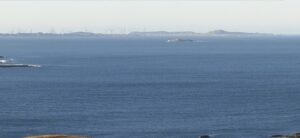
Image by SPR with vantage point adjusted – turbines visible at Loch na Keal.
Iona’s historic monuments – including the Abbey and Nunnery – also mean that the surrounding seascape forms part of a nationally important cultural landscape setting.
Landscape studies such as the Argyll and the Firth of Clyde Landscape Character Assessment describe this region as an exposed Atlantic island landscape highly sensitive to large structures.
Taken together, these factors mean the proposal could reasonably be argued to cause:
• major adverse landscape effects
• significant visual impacts from key viewpoints
• a nationally significant change in landscape character
Endnote on images methodology
SPR’s photomontages are wide-angle, which result in “perspective distortion” (distant objects appear smaller, nearer objects may appear enlarged) and do not portray the image as the human eye would see them.
SPR has produced one single photomontage so far from Iona (Dun I).
The SPR images, including the one from Iona, are illustrative visualisations. The images in this document are illustrative visualisations of what the turbines could look like from significant viewpoints, prioritising how the human eye sees, with careful and transparent methodology, and technical comments welcomed from SPR or other parties:
Images 1 and 4: using SPR’s photomontages taken from Dun I and Loch na Keal which are adjusted to create a different vantage point thereby at least partially offsetting the “perspective distortion” inherent to wide-angle images;
Image 3: SPR’s graphic of the turbines viewed from Staffa, unamended (other than
arrow identifying Iona).